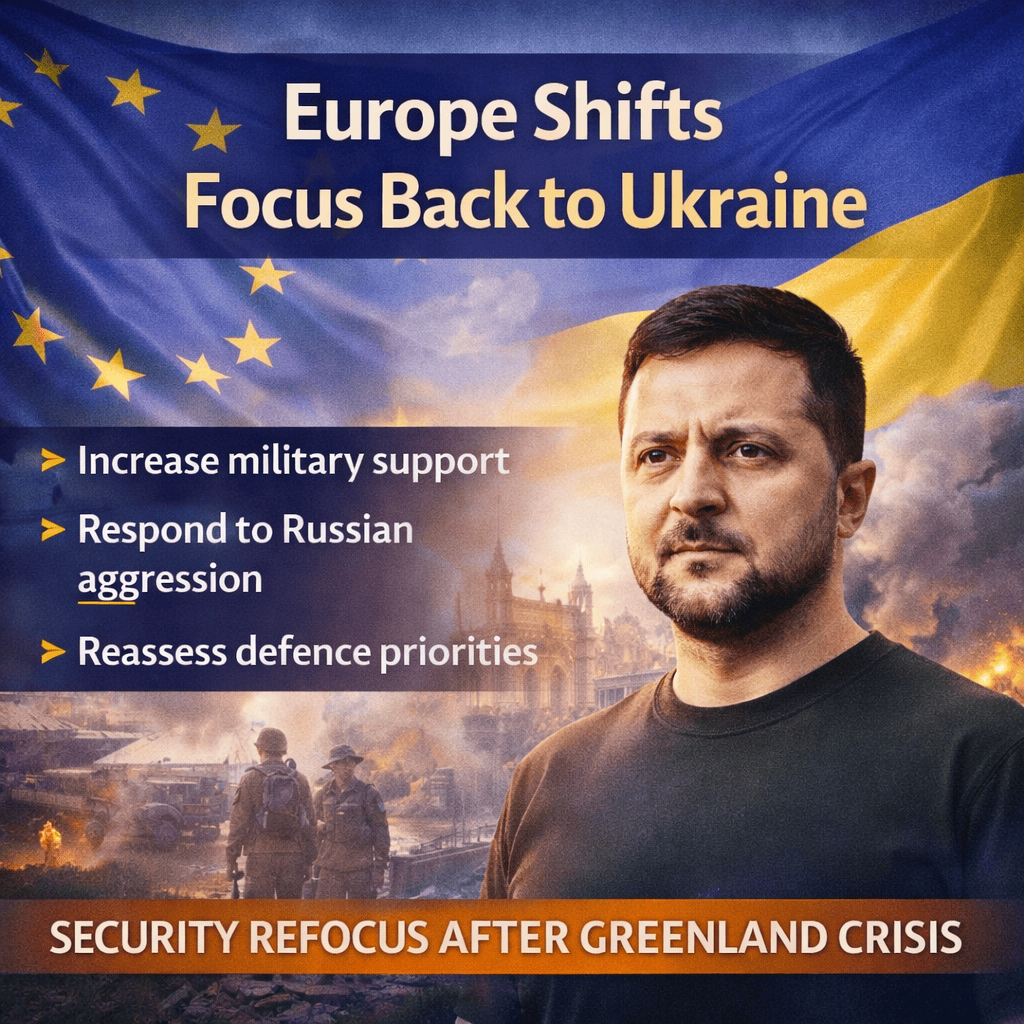
Europe shifts focus back to Ukraine following a tense week of diplomatic turbulence triggered by the Greenland crisis. The brief escalation—sparked by U.S. threats of tariffs over Greenland and renewed pressure to acquire the territory—caused political disruption across European capitals. But EU leaders now appear united in their intention to refocus on Ukraine, where the war with Russia continues to shape Europe’s security agenda.
The Greenland dispute, reignited by U.S. President Donald Trump’s aggressive rhetoric, triggered swift condemnation from Brussels and strong solidarity with Denmark. For several days, political bandwidth was consumed by debates over sovereignty and transatlantic reliability. Now that that crisis is de-escalating, the strategic priority reasserts itself: Ukraine.
Europe shifts focus back to Ukraine as officials in Brussels emphasize continuity in military and financial support. NATO’s Secretary General has urged member states to maintain high levels of defence spending, with renewed focus on long-range capabilities and sustained arms shipments to Kyiv. The conversation has expanded beyond tactical support to include longer-term capability building, cybersecurity, and integrated air defence.
Ukrainian President Volodymyr Zelenskyy has publicly called out the temporary distraction, accusing European leaders of entering a “Greenland mode” while his country faces existential threats. His comments underscore the frustration in Kyiv about wavering political attention. He’s made clear that Ukraine cannot afford to be a second-tier concern while Russia escalates hybrid and conventional attacks.
Europe shifts its focus back to Ukraine not only because of frontline needs but also because of strategic implications. EU policymakers are increasingly aware that Russian military and cyber capabilities could pose a threat to NATO’s eastern flank if unchecked. Sustained engagement in Ukraine, therefore, serves broader deterrence goals, keeping potential spillovers in check.
This renewed commitment intersects with EU policy debates on defence-industrial cooperation. European Commission officials have stressed the need to strengthen dual-use technologies, streamline defence procurement, and ensure that defence innovation isn’t dependent on volatile global supply chains. Ukraine has become the real-world testing ground for many of these shifts.
Even amid internal EU debates over budget allocations and sovereignty clauses, there’s a growing consensus that drifting away from Ukraine undermines Europe’s long-term credibility. The current reset signals that Europe is shifting its focus back to Ukraine, not simply out of obligation, but to reinforce the foundations of European security and sovereignty.
That pivot may not resolve all internal divisions, but it does re-anchor Europe’s geopolitical posture around a conflict that remains far from resolved.