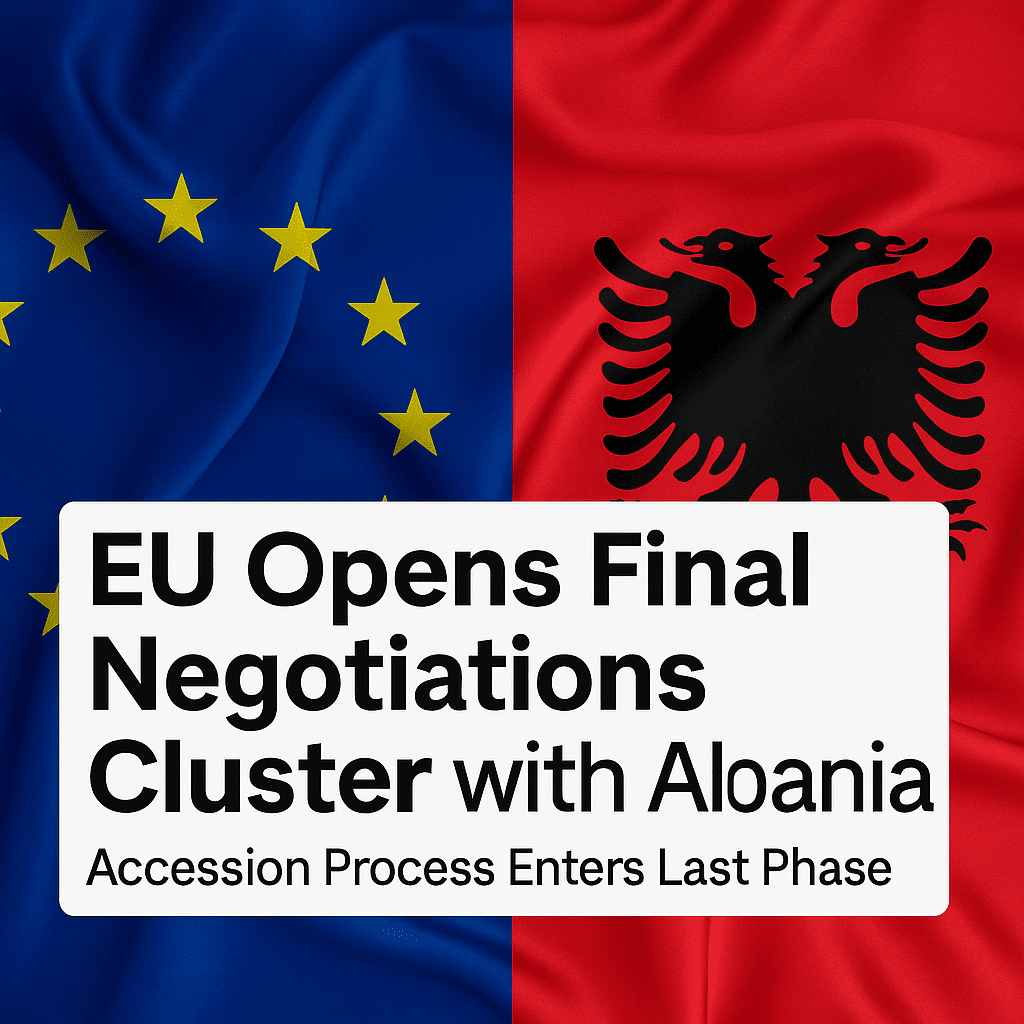
During the seventh EU–Albania Intergovernmental Conference in Brussels, the EU opened the final negotiations cluster with Albania, marking the most advanced stage of Albania’s accession process. With Cluster 5 — Resources, Agriculture and Cohesion — now formally opened, Albania is negotiating across all six clusters under the EU’s reformed enlargement framework.
Cluster 5 carries significant weight. It covers agriculture, food safety, rural development, fisheries, and the cohesion policies that regulate how EU funds are allocated and monitored. By moving into this stage, the EU opens final negotiations with Albania only after concluding that the country has met the preparatory benchmarks tied to regulatory standards, agricultural alignment, and administrative capacity.
Diplomatic assessments interpret this step as a signal that Albania remains among the frontrunners in the Western Balkans. Brussels officials have pointed to a realistic timeline: negotiations could close by 2027 if reforms continue at their current pace, positioning Albania for potential membership around 2030. That estimate is speculative but consistent with the recent momentum in the enlargement agenda.
Yet progress remains conditional. EU institutions stress that justice reform, judicial independence, and anti-corruption measures remain decisive. The “Fundamentals” cluster — which governs the rule of law and democratic standards — remains open until the entire negotiation process concludes, meaning any slowdown in these areas could delay the broader timeline. The EU opens final negotiations cluster with Albania while still requiring stronger investigative and prosecutorial performance in corruption cases.
Prime Minister Edi Rama welcomed the move, arguing that the process delivers tangible changes well before membership. He highlighted improvements in public governance, procurement transparency, and institutional stability as examples of how domestic systems are already aligning with EU standards. For him, the EU opens final negotiations cluster with Albania not just as a procedural milestone but as a validation of long-term structural reforms.
For investors, policymakers, and civil society, this stage introduces a more precise roadmap. The country’s regulatory environment is increasingly predictable, particularly in agriculture, food safety, and cohesion fund management. If reform momentum continues, Albania’s alignment with EU norms may accelerate digitalisation, improve oversight of subsidies, and strengthen public-sector accountability — shaping a more stable policy environment as negotiations advance.