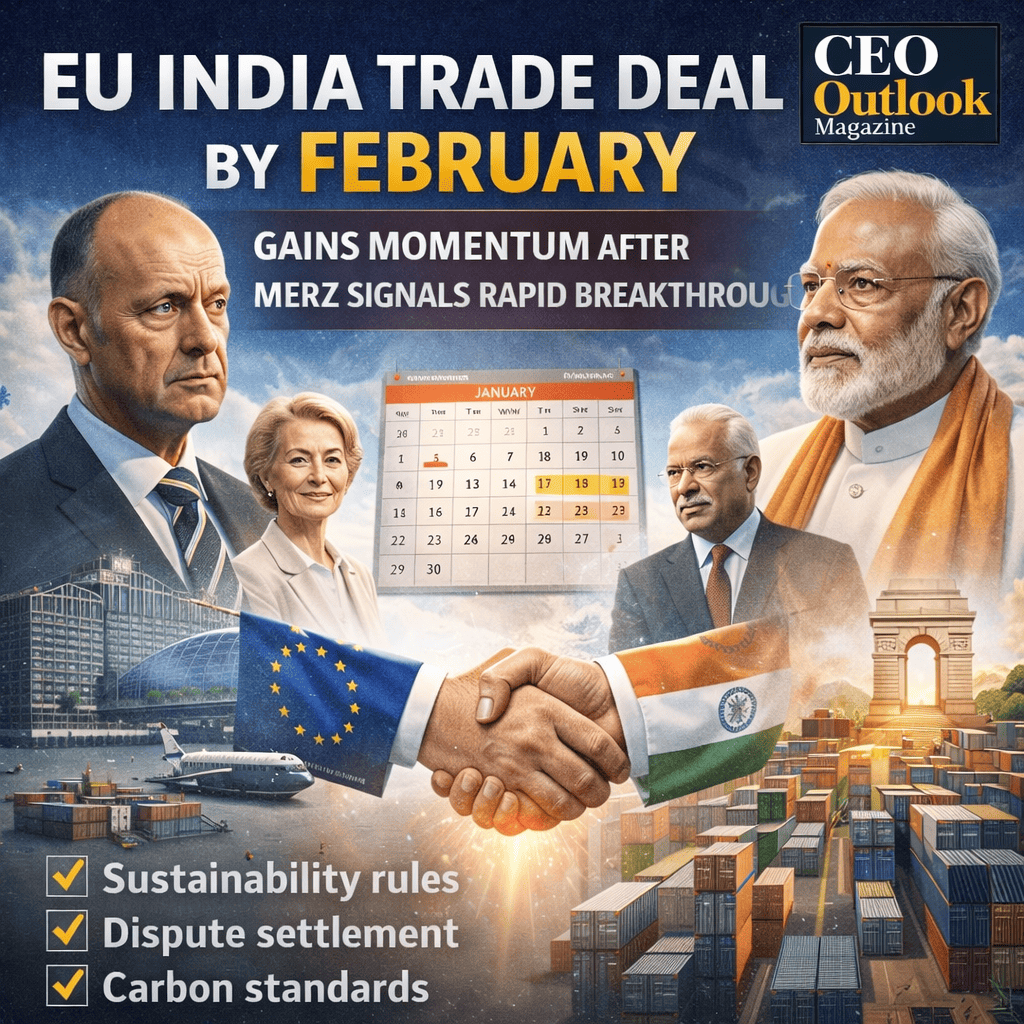
The EU India trade deal by February is no longer a distant ambition. German Chancellor Friedrich Merz has said the long-running agreement could be finalized within weeks, with European leaders potentially travelling to India in late January to sign it. If that schedule holds, a deal that has stalled for years could reach completion by February.
Merz made the remarks during a visit to India, framing the timeline as both realistic and strategically urgent. He said European Commission President Ursula von der Leyen and European Council President António Costa could join a summit in India if the remaining technical issues are resolved. The message from Berlin is clear: the negotiations are shifting from drafting mode to decision mode.
The push reflects a broader recalibration of Europe’s trade strategy. With protectionism rising globally and economic pressure intensifying between major powers, Brussels is seeking to accelerate the diversification of supply chains and export markets. India, now one of the world’s fastest-growing major economies, sits at the center of that effort.
For India, the agreement promises expanded access to European markets and deeper integration into global value chains. For the EU, it offers a strategic counterweight in Asia and a way to reduce dependence on a narrow set of partners. That alignment has compressed political timelines that once stretched indefinitely.
Momentum has also been building behind the scenes. India’s commerce minister has been in Brussels holding intensive talks with the EU’s trade leadership, narrowing differences that previously blocked progress. Negotiators are now focusing on a short list of unresolved issues rather than entire chapters.
The most challenging terrain remains sustainability and enforcement. The EU wants binding commitments on labor and environmental standards, supported by dispute-settlement mechanisms. India has resisted elements that could expose domestic policy to external arbitration. Another flashpoint is Europe’s Carbon Border Adjustment Mechanism, which India views as a de facto tariff on carbon-intensive exports.
These disputes are no longer abstract. They now determine whether the EU-India trade deal becomes reality by February or slips once more into “later this year” territory.
Three signals will define the coming days:
- Confirmation of a late-January EU–India summit
- Final language on sustainability enforcement
- Clarity on how carbon rules interact with market access
If those pieces align, the agreement could move directly from negotiation to signature.
Speculation (flagged): A rapid deal would likely rely on political-level compromises rather than perfect technical alignment. Both sides may accept calibrated ambiguity—locking in tariff cuts and market access now, while deferring some enforcement mechanics to future review cycles.
What makes this moment different is urgency. Europe wants to demonstrate that it can still conclude major trade agreements in a fragmented world. India wants to anchor itself more firmly in global commerce while retaining policy autonomy.
The EU India trade deal by February is therefore not just a commercial milestone. It is a test of whether two large, complex economies can move quickly when geopolitics compress time.