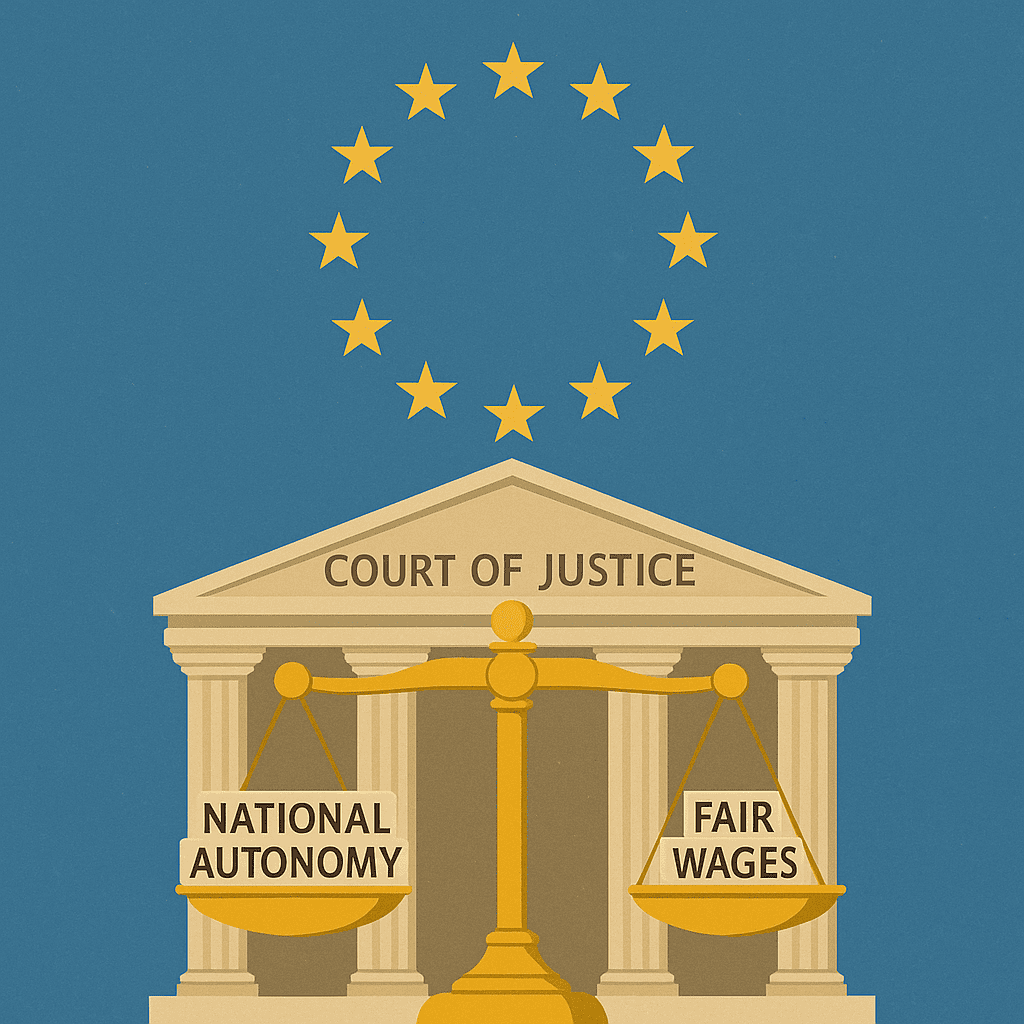
The European Court of Justice (ECJ) has rejected Denmark’s legal attempt to annul the EU’s directive on adequate minimum wages, confirming that the legislation does not infringe on member states’ sovereignty in wage-setting. The ruling secures the future of a landmark European law aimed at improving pay standards and reducing wage inequality across the bloc.
Denmark, supported by Sweden, argued that wage regulation falls strictly under national jurisdiction and that the directive on adequate minimum wages interferes with the Nordic model of collective bargaining. In this system, wages are negotiated directly between employers and trade unions, without government intervention.
In its decision, the ECJ ruled that the directive respects national autonomy while establishing minimum procedural obligations to ensure fair wages and working conditions. The court stated that the law’s goal is to strengthen social dialogue and collective bargaining coverage, rather than imposing a single EU-wide minimum wage.
The judgment maintains the directive’s central framework:
Member states must assess the adequacy of their minimum wages based on economic criteria such as purchasing power and cost of living.
Governments should promote broader collective bargaining agreements.
Transparent mechanisms must be in place to regularly update and monitor minimum wage standards.
However, the ECJ partially annulled two provisions: one detailing the specific parameters for assessing adequacy and another limiting the ability of member states to adjust indexed wages automatically. These technical removals do not alter the directive’s overall intent.
The decision means all EU countries — including those without statutory minimum wages — must adapt their national systems to comply by late 2024. For Denmark and Sweden, implementation will rely on ensuring that collective bargaining continues to deliver adequate wage protection.
Speculatively, experts believe this verdict may serve as a foundation for broader EU influence over labor standards, signaling that the Union can legislate for social fairness while respecting diverse wage-setting traditions.
The directive on adequate minimum wages now stands as a defining moment for Europe’s social policy — balancing market freedom with the principle of fair pay.