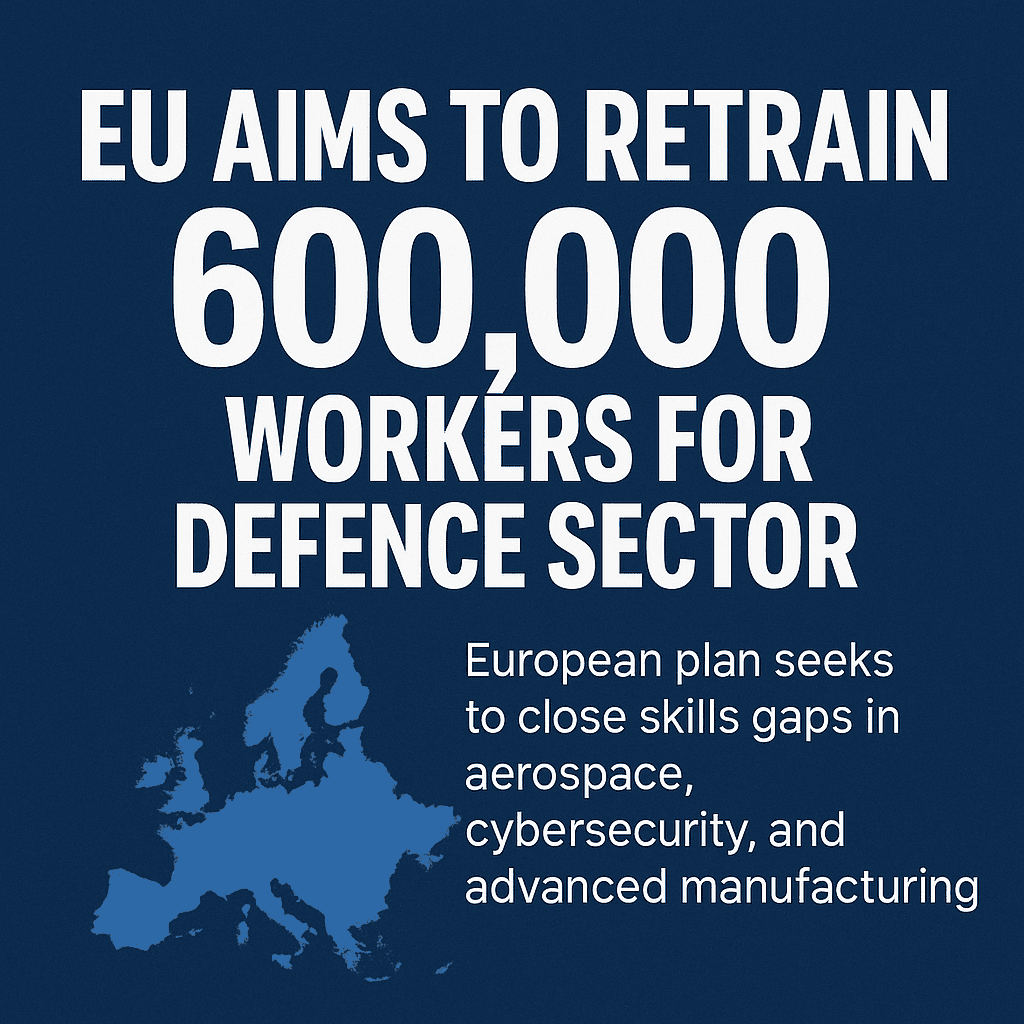
The European Commission’s new workforce strategy places unprecedented emphasis on strengthening Europe’s defence industrial base. The plan — under which the EU aims to retrain 600000 workers for defence sector roles — reflects the bloc’s urgent need to close skills gaps in critical areas including aerospace engineering, advanced manufacturing, cybersecurity, missile-system integration, and dual-use digital technologies.
When assessing why the EU aims to retrain 600000 workers for the defence sector, officials point to a severe shortage of qualified technicians and engineers. Defence companies across the EU report tens of thousands of unfilled positions, while ageing workforces and global supply-chain competition push Europe toward long-term vulnerability. In particular, firms producing air-defence platforms, drones, electronic warfare systems, and precision munitions highlight recruitment gaps that could slow production during periods of heightened geopolitical risk.
The training initiative, part of the European Defence Industrial Strategy, will combine EU funding, national programmes, and private-sector partnerships. Because the EU aims to retrain 600000 workers for the defence sector, Brussels intends to deploy a mix of vocational upskilling, university-industry collaboration, and specialist certifications. Programmes will span entry-level technician pathways to advanced systems-engineering tracks, with priority given to cross-border training mobility to enable companies to hire from a wider talent pool.
The strategic rationale behind the EU’s aim to retrain 600,000 workers for the defence sector extends beyond traditional defence manufacturing. New EU policy emphasises dual-use technologies — components and systems usable in both civilian and defence settings. This includes secure communications, quantum-safe encryption, AI-driven situational awareness platforms, and next-generation robotics. Strengthening these capabilities supports broader European technological sovereignty.
Opportunities exist for more innovative approaches:
• AI-based skills-mapping systems could identify underutilised talent, such as graduates in adjacent fields or workers displaced from automotive and energy industries.
• VR and mixed-reality simulators could train aircraft maintenance crews, drone operators, and cyber-monitoring personnel at scale.
• Performance-linked retraining contracts may reduce labour-market friction by guaranteeing job placement within months of programme completion.
Ultimately, because the EU aims to retrain 600000 workers for the defence sector, Europe is signalling a structural shift — one in which industrial readiness, workforce resilience, and strategic autonomy are now inseparable.