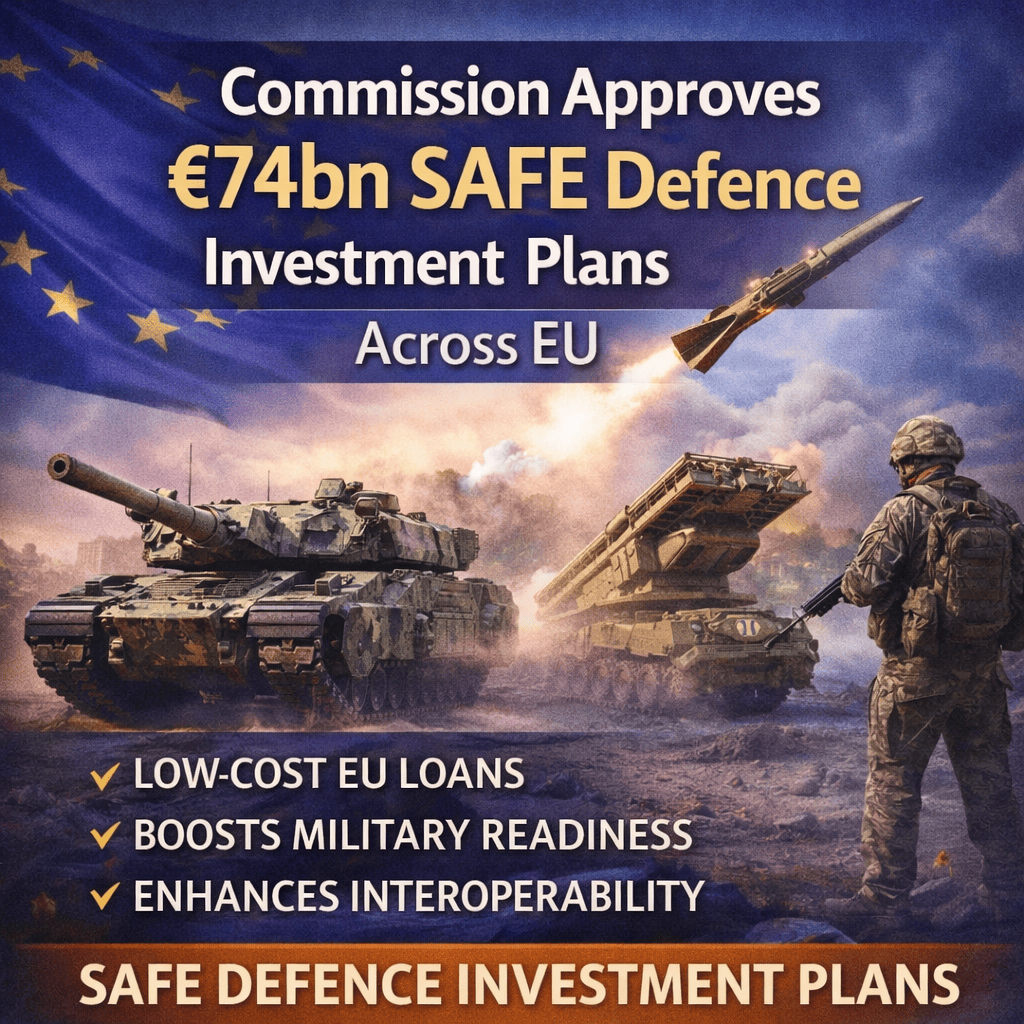
The European Commission has cleared a new wave of SAFE defence investment plans worth €74 billion, extending low‑interest EU loans to eight additional member states under the Security Action for Europe (SAFE) framework. The approvals deepen Brussels’ shift toward collective defence financing, aimed at closing capability gaps and accelerating procurement across the bloc.
This round follows an earlier batch approved in mid‑January and brings the SAFE programme closer to becoming the EU’s central financial engine for military modernisation. The objective is structural: replace fragmented national buying with coordinated investment, reduce duplication, and ensure forces can operate together in real conditions.
Poland emerges as the largest beneficiary, with more than €40 billion earmarked for its programme. The scale reflects its frontline role on NATO’s eastern flank and its fast‑paced rearmament drive. Romania, France, Italy, and Hungary are also included in this tranche, each submitting national plans aligned with EU priorities such as air and missile defence, armoured mobility, secure communications, logistics, and stockpiles.
The SAFE defence investment plans function as long‑term loans on preferential terms, allowing governments to move faster without blowing through domestic budgets. For countries under fiscal pressure, SAFE changes the timing equation: instead of stretching procurement over a decade, ministries can place large orders now and amortise the cost later. That speed matters in a security environment shaped by Russia’s war in Ukraine and persistent uncertainty about future external guarantees.
Brussels is also using SAFE to reshape how Europe builds weapons. Funding is tied to interoperability and joint procurement, nudging governments toward shared platforms rather than bespoke national systems. The Commission’s defence directorate evaluates whether each plan supports EU‑wide capability goals. The message is clear: SAFE is not a cheque book; it is a steering mechanism.
The programme dovetails with the EU’s “Readiness 2030” agenda, which frames defence as industrial policy as much as security policy. Loan‑backed demand offers European manufacturers predictable order books, encouraging capacity expansion in areas such as drones, ammunition, air defence interceptors, and encrypted networks. Over time, SAFE could do for defence what pandemic recovery funds did for energy and infrastructure: create scale through centralised finance.
Council approval remains the final procedural step. Once adopted, individual loan contracts can be signed and disbursements begin, likely within months. More member states are preparing submissions, suggesting the volume of SAFE defence investment plans will grow rapidly through 2026.
The strategic implication is deeper than the headline figure. SAFE shifts defence from a patchwork of national decisions into a semi‑federal investment model. If sustained, it changes how Europe prepares for conflict—less as 27 separate buyers, more as a single market for security.