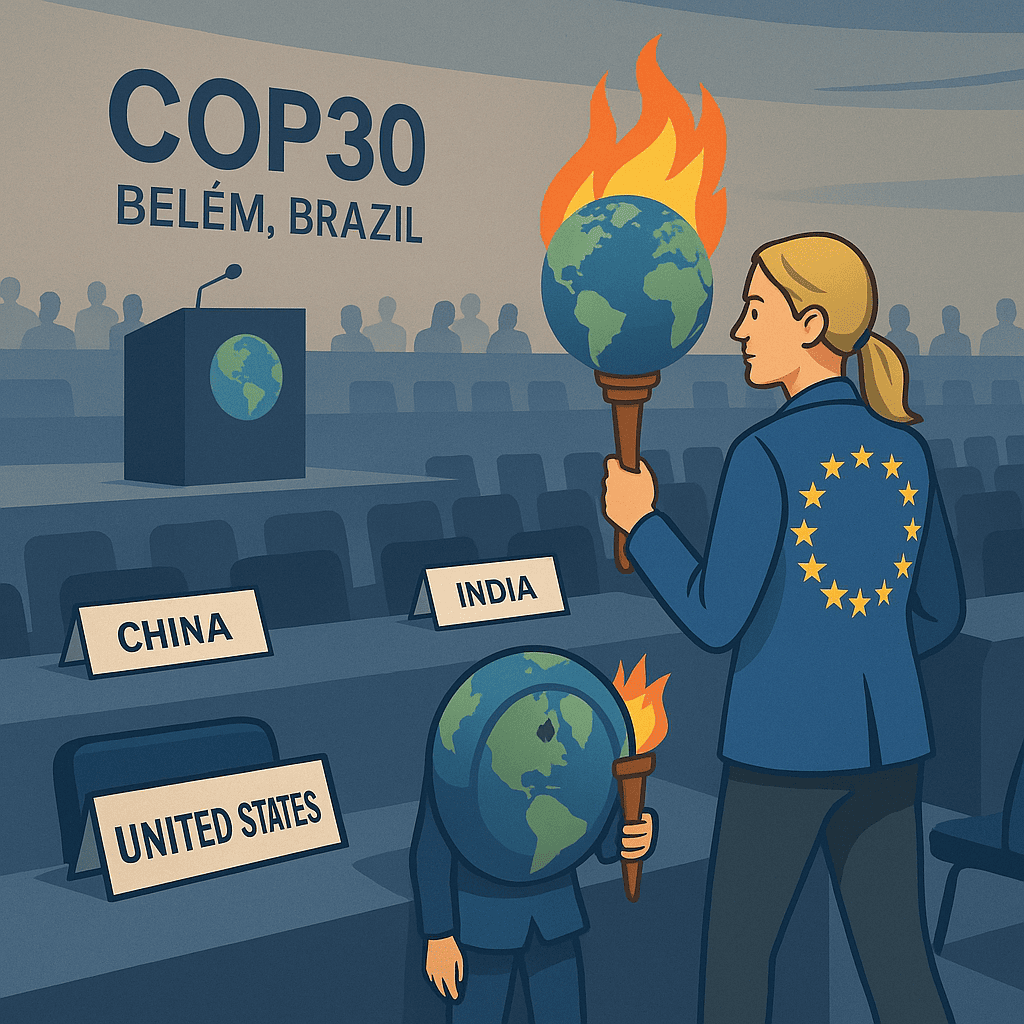
The decision by major global emitters to skip COP30 has thrown a shadow over this year’s crucial climate summit in Belém, Brazil. With the United States, China, and India—collectively responsible for nearly half of global greenhouse-gas emissions—absent from the talks, the responsibility of sustaining global climate momentum has once again mainly fallen on Europe.
For the European Union, the absence of these major players in the COP30 negotiations poses a severe diplomatic and financial test. Brussels is now expected to take the lead in funding global climate action while managing its own energy-transition costs and economic slowdowns at home. Yet, European leaders privately admit that they cannot meet global targets alone if the world’s biggest emitters continue to skip COP30 and other key climate platforms.
The summit’s agenda—focused on climate finance, adaptation support, and loss-and-damage compensation—was undermined by the no-shows. Developing nations, already hit hardest by climate change, voiced frustration that wealthier polluters were not at the table to negotiate binding contributions. The symbolism of empty chairs for the U.S., China, and India was not lost on observers.
Analysts warn that by choosing to skip COP30, these countries risk creating a leadership vacuum. Without unified participation, the credibility of global climate governance could weaken, prompting other nations to scale back their own commitments. Europe, despite its ambitions, remains limited in capacity, contributing around 6% of global emissions, compared with China’s 29%, the U.S.’s 11%, and India’s 8%.
If this pattern continues, global emissions may climb again by 2026, offsetting years of progress under the Paris Agreement. To avoid such a scenario, Europe must build new coalitions—including climate partnerships with Latin America and Africa—and push for innovative financing tools, such as green bonds and AI-based carbon monitoring, to maintain global accountability and transparency.
The decision by the biggest polluters to skip COP30 doesn’t just signal diplomatic fatigue—it exposes a growing divide in climate responsibility that could define the next decade of international relations.