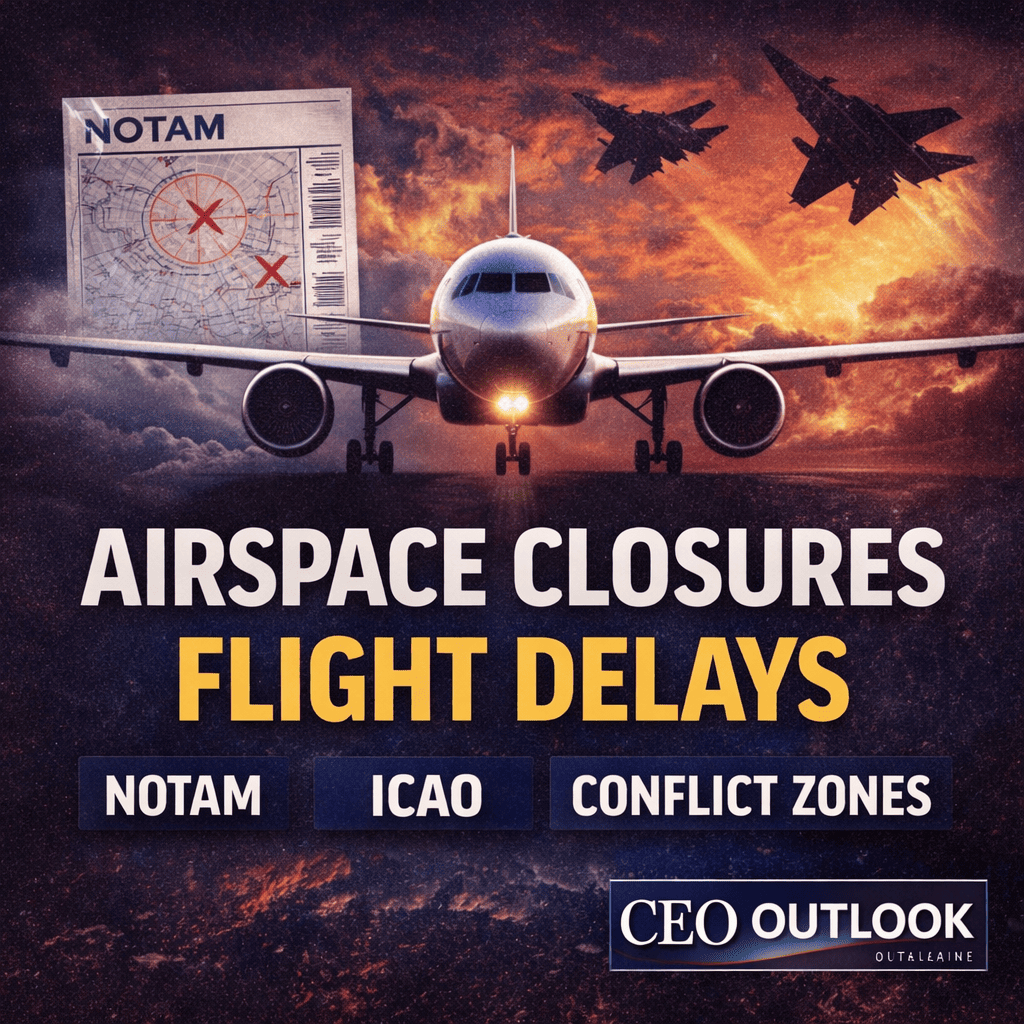
Airspace closures and flight delays have become a defining feature of modern air travel as conflicts and security risks repeatedly shut down major corridors across the Middle East, Eastern Europe, and parts of Asia. What passengers experience as longer journeys is, in reality, the result of a tightly choreographed safety system that reroutes thousands of aircraft without compromising separation, crew limits, or operational margins.
Every closure begins with sovereign authority. Under international aviation law, each state controls its own skies. When risk rises, authorities issue a NOTAM (Notice to Airmen), instantly removing that airspace from commercial use. From that moment, airline operations centres and air traffic control networks re-map flows in real time. Routes that once crossed a single country are pushed into neighbouring corridors, often creating visible “streams” of aircraft on tracking maps.
This is not improvisation. The industry plans for it.
Airlines maintain multiple approved routings for every long-haul city pair. Dispatch teams run layered risk assessments—strategic, daily, and pre-departure—using intelligence from regulators, insurers, and global safety bodies. Even if airspace is technically open, a carrier may still avoid it if its internal thresholds are breached. Safety overrides cost, fuel burn, and schedule pressure.
The second stabiliser is capacity control. When traffic concentrates into fewer corridors, air traffic control meters flow. Controllers assign extra track miles, stretch arrival sequences, or slightly lengthen cruise segments to keep aircraft safely separated. This demand–capacity balancing is standard network management, not an emergency fix. In Europe and the North Atlantic, pre-agreed contingency scenarios already exist to absorb sudden surges.
Conflict zones add a third layer. Regional coordination cells—often involving ICAO, IATA, and national aviation authorities—design “contingency routes” that thread aircraft through safer portions of a region. In some cases, this avoids multi-hour detours, adding only 20–40 minutes. The objective is continuity without exposure.
For travelers, airspace closures and flight delays usually mean longer flight times rather than mass cancellations. Crews remain within duty limits, fuel margins are recalculated, and aircraft continue operating—just on wider arcs. The disruption appears downstream: missed connections, late arrivals, and compressed turnaround windows.
How to reduce your exposure to airspace closures and flight delays:
- Book earlier departures to create recovery time.
- Avoid tight connections on long-haul itineraries.
- Choose routes with higher daily frequency.
- Keep essentials in carry-on baggage.
- Monitor airline apps, not social feeds—dispatch updates arrive there first.
Prediction (flagged): As geopolitical volatility becomes semi-permanent, expect airlines to embed “dynamic corridor pricing” into schedules—routes designed from day one to tolerate airspace loss without cascading delays. AI-driven flow forecasting will replace static seasonal planning.
Airspace closures and flight delays are not a sign of fragility. They are proof of a system designed to bend without breaking.