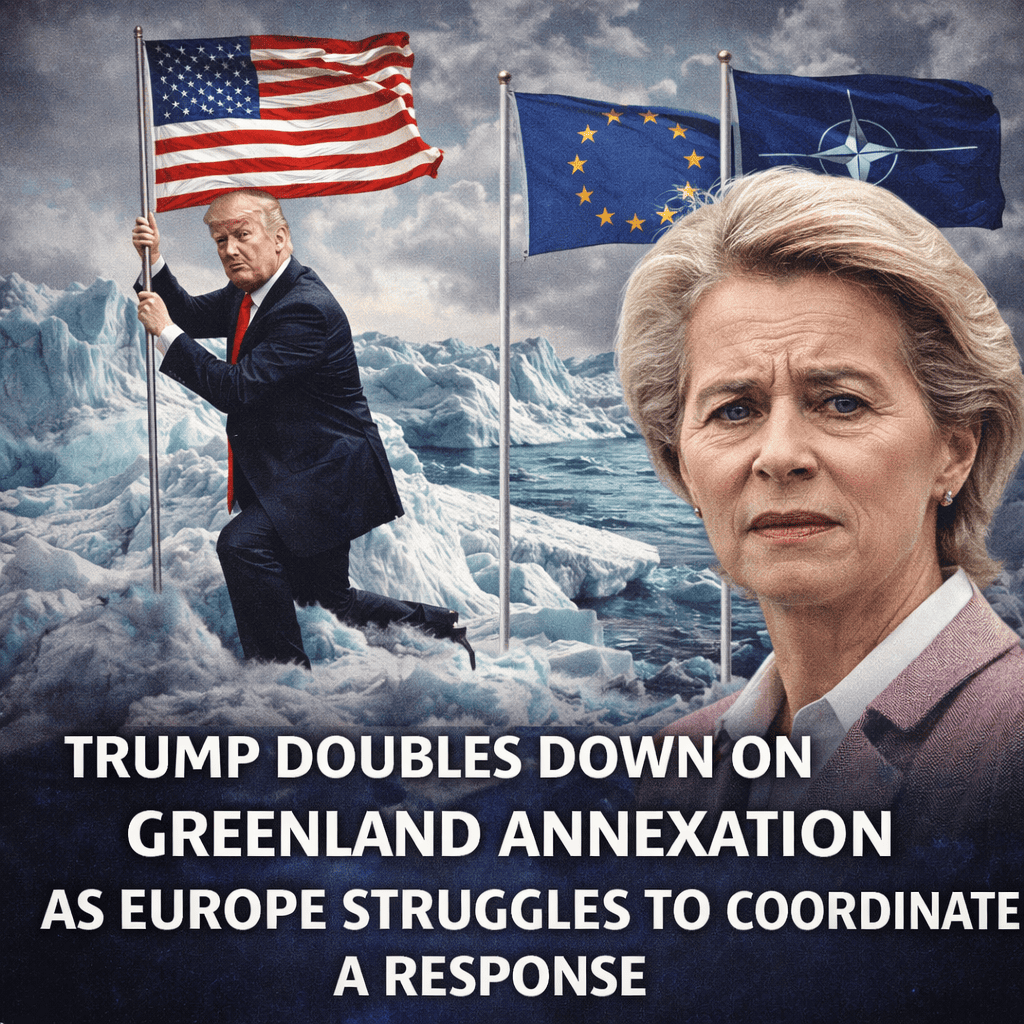
Trump doubles down on Greenland annexation, and Europe is confronting how fragile alliance coordination becomes when pressure comes from inside the Western camp. The latest escalation followed a social media post in which Trump shared a digitally generated image of himself planting a US flag on Greenland’s ice—an unmistakable signal that his interest in acquiring the Danish territory is not rhetorical.
The move lands in a tense trade environment. US officials have urged European governments not to retaliate, even as Brussels and national capitals debate countermeasures tied to Greenland-related tariff threats. The EU’s dilemma is structural: it can act quickly on trade, far more slowly on security. NATO, by contrast, can coordinate defence, but political consensus inside the alliance is harder when the challenge originates in Washington.
That is why Trump doubles down on Greenland annexation, exposing a gap between principle and practice. European leaders agree on the red line—Danish and Greenlandic sovereignty is non-negotiable. What they lack is a single operational response that blends diplomacy, deterrence, and economic leverage without fracturing the broader relationship with the United States.
European Commission President Ursula von der Leyen has tried to frame the issue as an allies-first one. In Davos, she underlined that sovereignty and territorial integrity are not bargaining chips and announced work on an Arctic security package. The aim is twofold: remove any pretext that Greenland’s security is inadequate and show that Europe can invest in the region—icebreakers, surveillance, and infrastructure—without inviting escalation.
Yet Trump doubles down on Greenland annexation while Europe hesitates over tactics. Some in Brussels argue for an “economic Article 5” logic—collective trade defence when an ally’s territory is pressured. Others warn that retaliation in areas like services, where the US runs a surplus, could trigger a wider clash that Europe is not prepared to manage. The result is caution layered on caution.
The geopolitical cost of drift is visible. Moscow has seized on the dispute, framing it as a NATO fracture and portraying Denmark’s position as colonial. That narrative benefits Russia in the Arctic and beyond. When allies argue in public, third parties fill the vacuum.
Three dynamics now shape the next phase:
- Alliance credibility: If Trump doubles down on Greenland annexation again, Europe’s response will test whether collective defence extends beyond tanks to trade and territory.
- Deterrence without rupture: Europe needs tools that signal resolve without detonating the transatlantic relationship.
- Arctic capacity: Security investment is no longer optional; it is the foundation for any diplomatic line.
A coherent answer requires two tracks moving together. First, a NATO-led Arctic uplift that removes any “security gap” narrative. Second, an EU trade-and-investment package for Greenland that strengthens resilience and prosperity. Statements alone will not hold the line. If Trump doubles down on Greenland annexation once more, Europe’s credibility will rest on whether those tracks arrive at the same destination—firm, united, and operational.