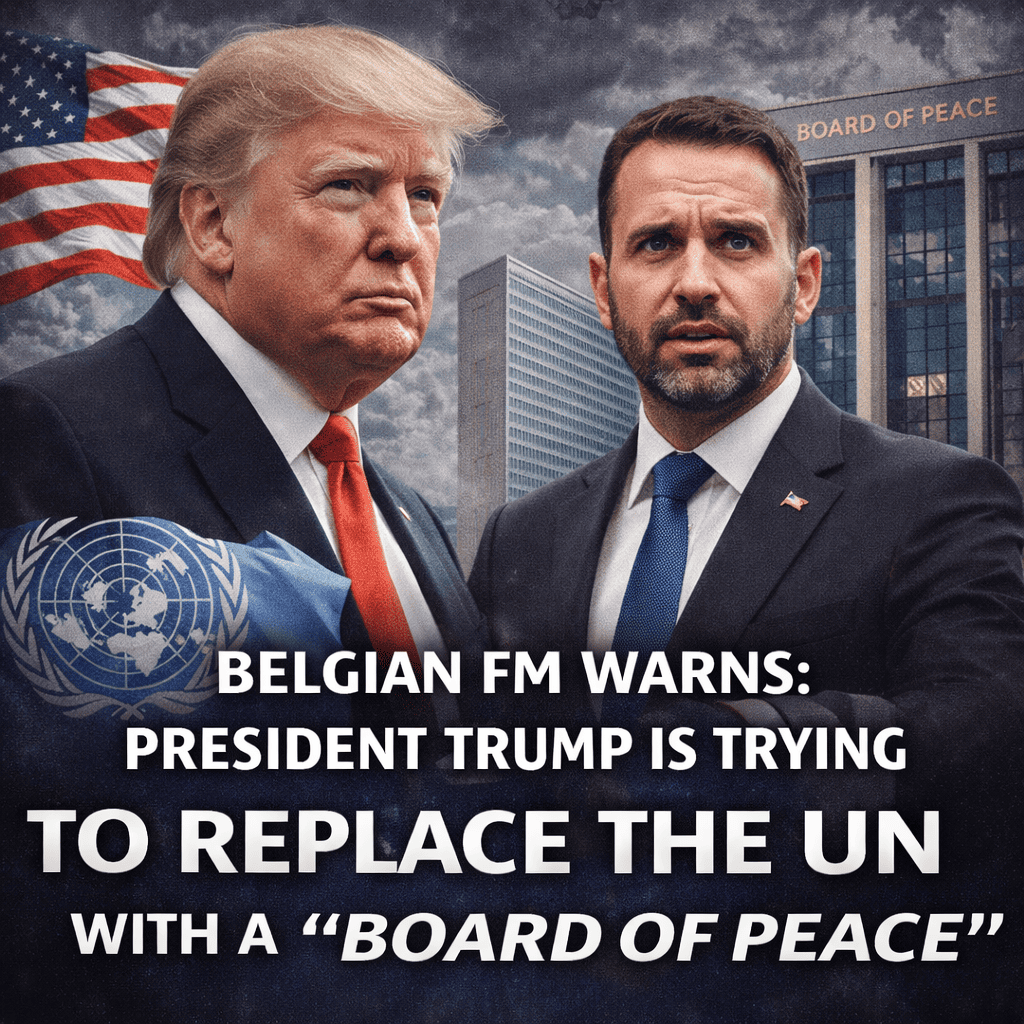
President Trump is trying to replace the UN, Belgian Foreign Minister Maxime Prévot said in Davos, arguing that Washington’s push for a new “Board of Peace” signals more than a tactical workaround for Gaza. In remarks to European media, Prévot described the proposal as a step toward parallel governance—one that risks sidelining the multilateral system rather than fixing it.
The “Board of Peace” is framed by the Trump administration as a temporary body to oversee post-war Gaza. But European diplomats hear a broader ambition. Prévot warned that creating a US-led structure outside the United Nations would alter how conflicts are managed, shifting authority away from rules-based institutions toward ad-hoc coalitions.
Trump’s own words amplify those concerns. Asked whether the Board of Peace could replace the UN, he suggested it “might,” criticising the UN as ineffective. That answer reframes the idea from an emergency bridge to an institutional alternative. For Europe, that distinction is decisive. If a new forum becomes the default for crisis management, legitimacy no longer flows from global consensus but from membership in a select group.
That is why President Trump is trying to replace the UN as a rallying phrase in European capitals. The worry is not reform—many EU governments accept that the UN struggles with speed and enforcement. The concern is substitution. Once one conflict is routed outside UN channels, others can follow. Ukraine, Venezuela, or Sahel transitions could be decided in bespoke clubs rather than under broadly agreed rules.
The timing heightens the stakes. Trump has moved quickly on tariffs, security commitments, and alternative diplomatic tracks. In Davos, those moves dominated conversations, with the Board of Peace emerging as a test case for how far Washington is willing to go in bypassing existing architecture.
For business and policy leaders, three implications stand out:
- Fragmented governance: Parallel institutions reduce predictability. Sanctions regimes, compliance standards, and peacekeeping mandates could diverge by bloc.
- Alliance cohesion: Europe’s security debates become more difficult when partners disagree over which body confers legitimacy.
- Market volatility: When crisis management becomes discretionary, geopolitical risk premiums rise across energy, shipping, defence procurement, and currencies.
Prévot’s warning also points to a constructive response. If President Trump is trying to replace the UN because it is slow, Europe can make replacement less attractive by driving reform that delivers results. Faster emergency mandates, measurable performance for peace operations, and coalition funding inside the UN framework would address the effectiveness gap without rewriting the rules.
Europe’s bottom line is clear: reform can be negotiated; replacement changes the game. And that is why President Trump is trying to replace the UN. It has become more than a headline—it is a strategic alarm about who sets the terms of global order in the years ahead.