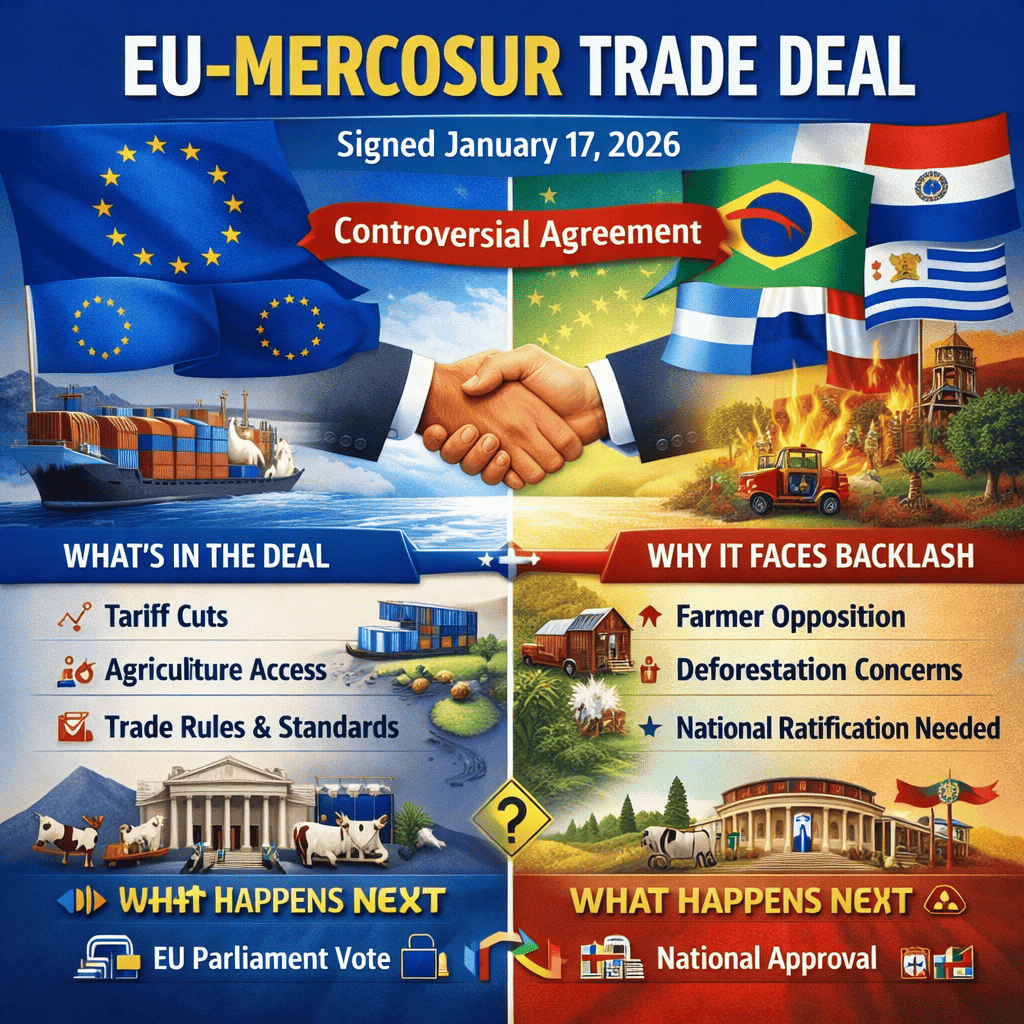
The EU-Mercosur trade deal was signed on 17 January 2026, ending one of the longest and most politically charged trade negotiations in modern European history. The agreement links the European Union with the Mercosur bloc—Argentina, Brazil, Paraguay, and Uruguay—creating a trade framework covering more than 700 million people and a combined economic output worth trillions.
The structure is deliberate. What was signed is not a single document, but a two-layer arrangement: a wider partnership agreement and a separate interim trade pillar. The interim track allows large parts of the commercial deal to take effect earlier, even while the complete agreement moves through national and EU-level ratification. Brussels designed this approach to lock in strategic gains while navigating domestic resistance inside member states.
Supporters frame the EU-Mercosur trade deal as a geopolitical necessity. With the United States turning more protectionist and China exerting growing influence across Latin America, EU leaders argue that Europe cannot afford to leave one of the world’s fastest-growing regions outside its trade architecture. The deal promises tariff reductions for European industrial goods, vehicles, machinery, pharmaceuticals, and services. In return, Mercosur exporters gain wider access to the EU market, especially for agricultural products.
The opposition is concentrated where economics collides with identity: farming and the environment. France, Ireland, and several agricultural lobbies warn that the EU-Mercosur trade deal exposes European farmers to competition from producers operating under different cost structures and regulatory regimes. Environmental groups argue that expanded beef and soy exports could intensify deforestation and weaken climate commitments. Their concern is not theoretical—supply chains in parts of South America remain difficult to monitor at scale.
Ratification is now the real test. The European Parliament must approve the agreement, and some of its parts require endorsement by national parliaments. That creates multiple veto points. A deal can be signed yet remain politically unstable for months or even years. The EU-Mercosur trade deal could become Europe’s largest trade agreement—or a symbol of overreach.
For policymakers, the next phase is less about persuasion and more about design. The debate cannot be resolved with rhetoric alone. Concrete mechanisms matter:
- Traceability must become infrastructure, not aspiration. Satellite monitoring, farm-level geolocation, and auditable supply chains reduce both environmental risk and political resistance.
- “Equivalence-plus” export frameworks—documenting welfare, pesticide use, and origin—can neutralize claims of unfair competition.
- Adjustment policies should be targeted. Transition funding for vulnerable farming segments is more effective than broad subsidies, which tend to entrench opposition.
Speculation (flagged): if ratification stalls, Europe is more likely to graft more vigorous enforcement and safeguard instruments onto the EU-Mercosur trade deal than abandon it outright. The strategic logic—diversifying partners, anchoring standards, and shaping global trade flows—has become central to Europe’s economic posture.
The deal’s future now rests on whether Europe can reconcile market ambition with environmental credibility and social cohesion.