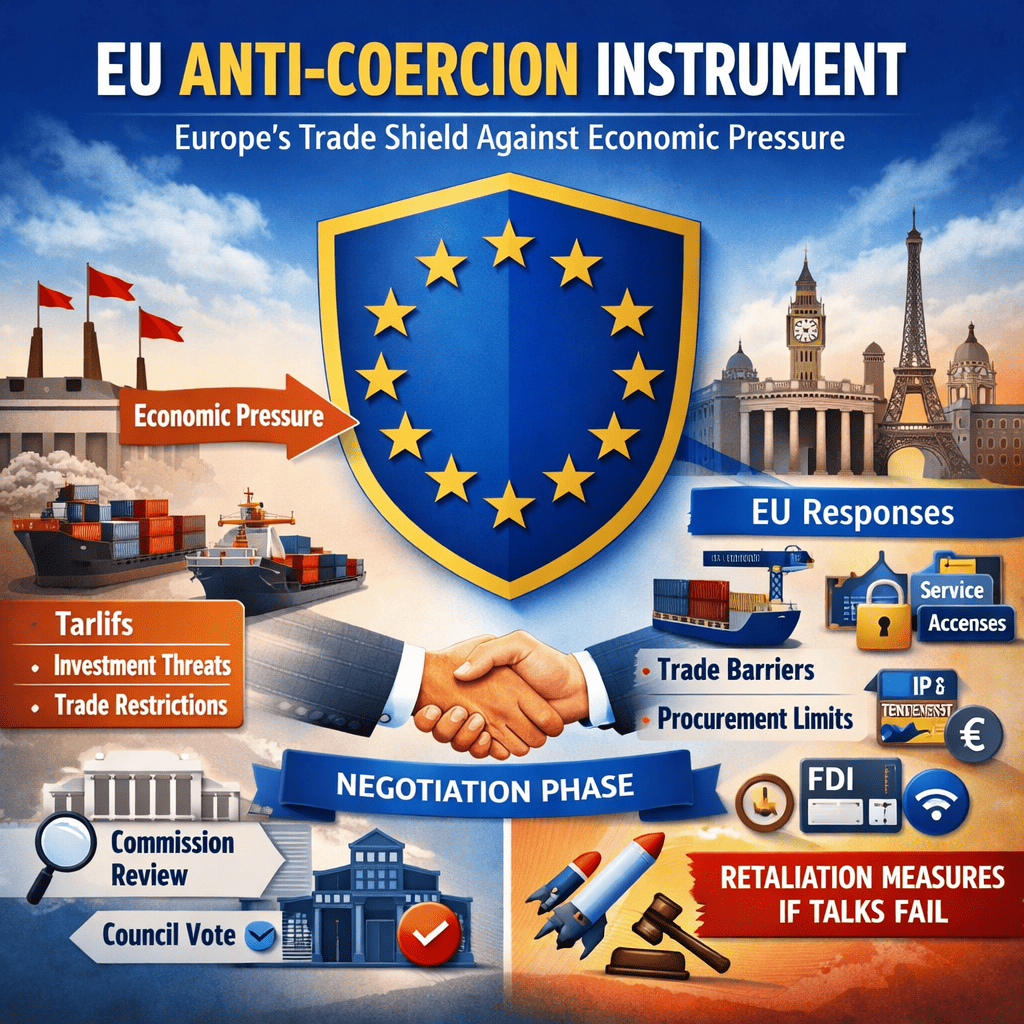
The EU anti-coercion instrument is the European Union’s formal response to economic pressure used for political ends. It was designed to address situations in which a non-EU country applies or threatens trade or investment measures to compel the EU or one of its member states to change a policy decision. The instrument has been in force since late 2023, but only now is it moving from theory into active political debate.
At its core, the EU anti-coercion instrument is about deterrence. The EU wants partners and rivals alike to know that economic pressure will no longer be cost-free. The goal is to stop coercive behaviour before it escalates, while keeping retaliation as a last resort. Unlike traditional trade disputes, which often drag on for years through international arbitration, this framework provides the EU with a faster, autonomous path.
The process begins when the European Commission or a member state raises concerns about coercion. The Commission then examines whether the actions in question meet the legal threshold: are they economic measures, and are they intended to force a political outcome? This assessment phase can last several months and requires evidence of intent, not just commercial harm.
If the Commission concludes that coercion is likely, the decision moves to EU governments. Member states vote by qualified majority on whether to formally activate the EU anti-coercion instrument. Activation does not immediately trigger retaliation. Instead, it opens a structured negotiation phase with the third country, prioritizing diplomacy.
Only if those talks fail does the instrument unlock countermeasures. These go far beyond standard tariffs. The EU can restrict access to its vast single market, including public procurement, regulated services, licensing regimes, and specific sectors. Measures can also affect investment, intellectual property rights, and participation in EU-funded projects. The design allows responses to be targeted, proportional, and reversible.
What makes the EU anti-coercion instrument strategically significant is its breadth. For many global firms, access to EU public contracts, certifications, or digital markets matters more than headline tariff rates. The instrument creates leverage in precisely those less visible areas where modern economies generate value.
This is why the tool is drawing attention amid rising geopolitical trade tensions. EU leaders are weighing whether tariff threats linked to political demands qualify as coercion. Some capitals argue that the instrument should be used early to establish credibility. Others prefer to exhaust diplomacy, warning that premature escalation could harden positions.
For businesses, the message is structural. The EU is shifting from reactive trade defence to strategic economic deterrence. Boards can no longer view trade risk purely in terms of customs duties. Exposure now includes procurement eligibility, regulatory approvals, data access, and IP protections.
Practical preparation goes beyond monitoring tariffs. Companies should map revenue tied to EU public contracts, regulated services, and licensing regimes. Contracts should be stress-tested for origin clauses and political-risk triggers. Crisis communication plans should anticipate sudden compliance checks or access limits.
The EU anti-coercion instrument signals a new era: economic pressure is being treated as a geopolitical weapon, and the EU is building its own counterweight. Whether it is used soon or remains a deterrent, its existence reshapes how power is exercised in global trade.