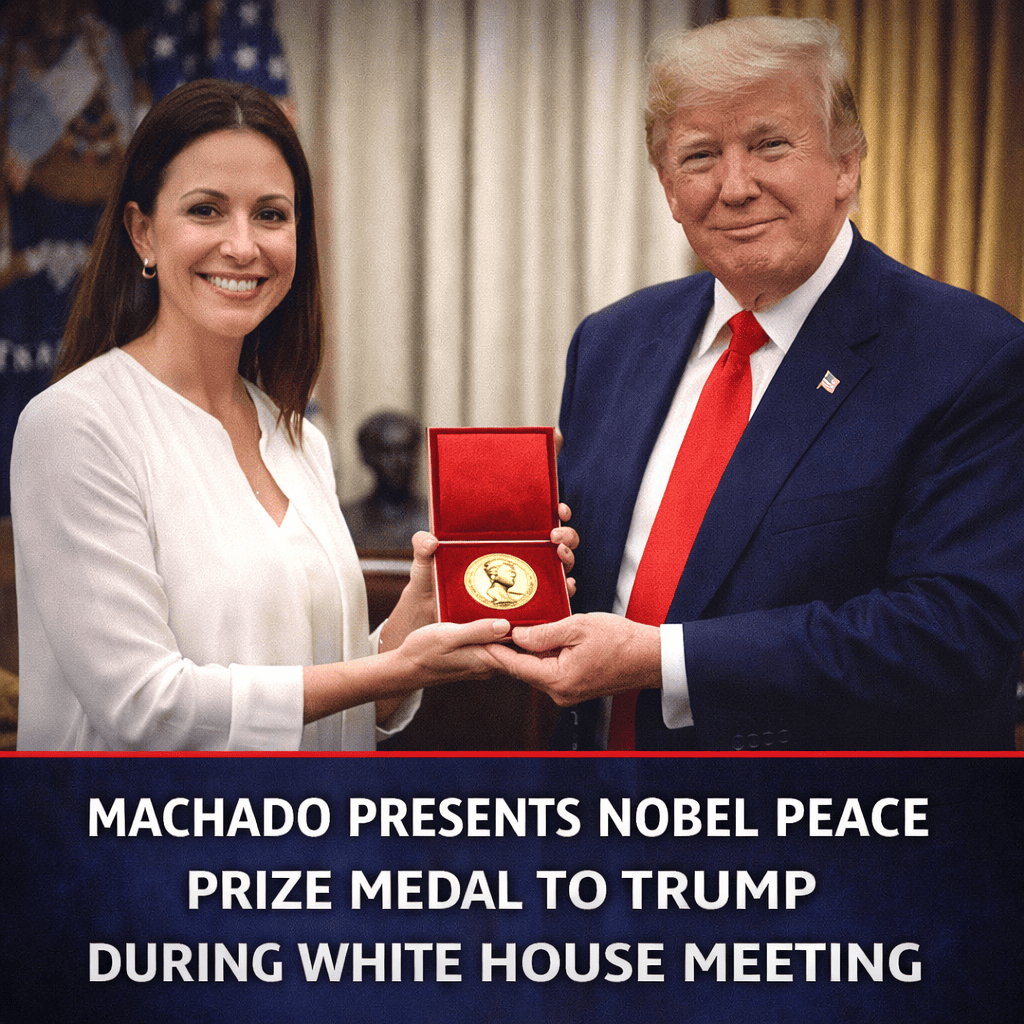
Machado presents the Nobel Peace Prize medal to Trump in a gesture that instantly turned a routine diplomatic meeting into a global headline. Venezuelan opposition leader María Corina Machado met US President Donald Trump at the White House and left behind her Nobel Peace Prize medal—an object Trump has long admired and publicly said he hoped to receive one day.
The symbolism was deliberate. By handing over the medal, Machado signalled trust, alignment, and urgency. The message was not subtle: Venezuela’s future is being shaped in Washington, and the opposition wants a seat at the table. Trump later acknowledged the gift on social media, calling the encounter an honour and confirming that Machado had left the medal for him.
The move sparked immediate debate. The Norwegian Nobel Committee clarified that while a physical medal can be given away, the Nobel Peace Prize itself cannot be transferred. Laureate status remains permanently with the original recipient. That clarification turned Machado presents Nobel Peace Prize medal to Trump into both a diplomatic gambit and a legal curiosity—powerful in optics, limited in formal meaning.
Timing gives the episode its weight. Venezuela is in political flux following the removal of long-time leader Nicolás Maduro, and Washington is reassessing its approach. Trump has signalled openness to engaging with the country’s interim leadership, even as lawmakers and international observers question whether genuine reform will follow. For Machado, the risk is that stability and energy access could eclipse democratic sequencing.
That explains why Machado presents Nobel Peace Prize medal to Trump is more than a ceremony. It is a bid to anchor US policy to opposition priorities: free elections, institutional reform, and guarantees against a cosmetic transition. Machado has spent weeks in Washington meeting bipartisan lawmakers, arguing that recognition, sanctions relief, and investment should be tied to clear democratic benchmarks.
The gesture has drawn criticism in Europe. Political figures in Norway called it inappropriate and damaging to the Nobel’s neutrality. That backlash highlights a trade-off Machado is making: maximizing influence in Washington while risking alienation in parts of Europe that remain wary of politicising the prize.
Three dynamics now define the aftermath:
- Access: The meeting confirms that Machado has direct access to Trump’s circle. That alone alters the balance of voices shaping US choices.
- Sequencing: (Speculation) Washington may prioritise stability and energy flows. The opposition will push to lock in elections and rule-of-law commitments first.
- Legitimacy battles: Expect sharper disputes over who represents “change” in Venezuela and what conditions unlock recognition.
In that context, Machado presents Nobel Peace Prize medal to Trump as a strategic conversion of symbolism into leverage. The medal cannot change hands in law. Its power lies elsewhere—in placing Venezuela’s opposition at the centre of a decision-making process that will determine how transition, sanctions, and reconstruction unfold.