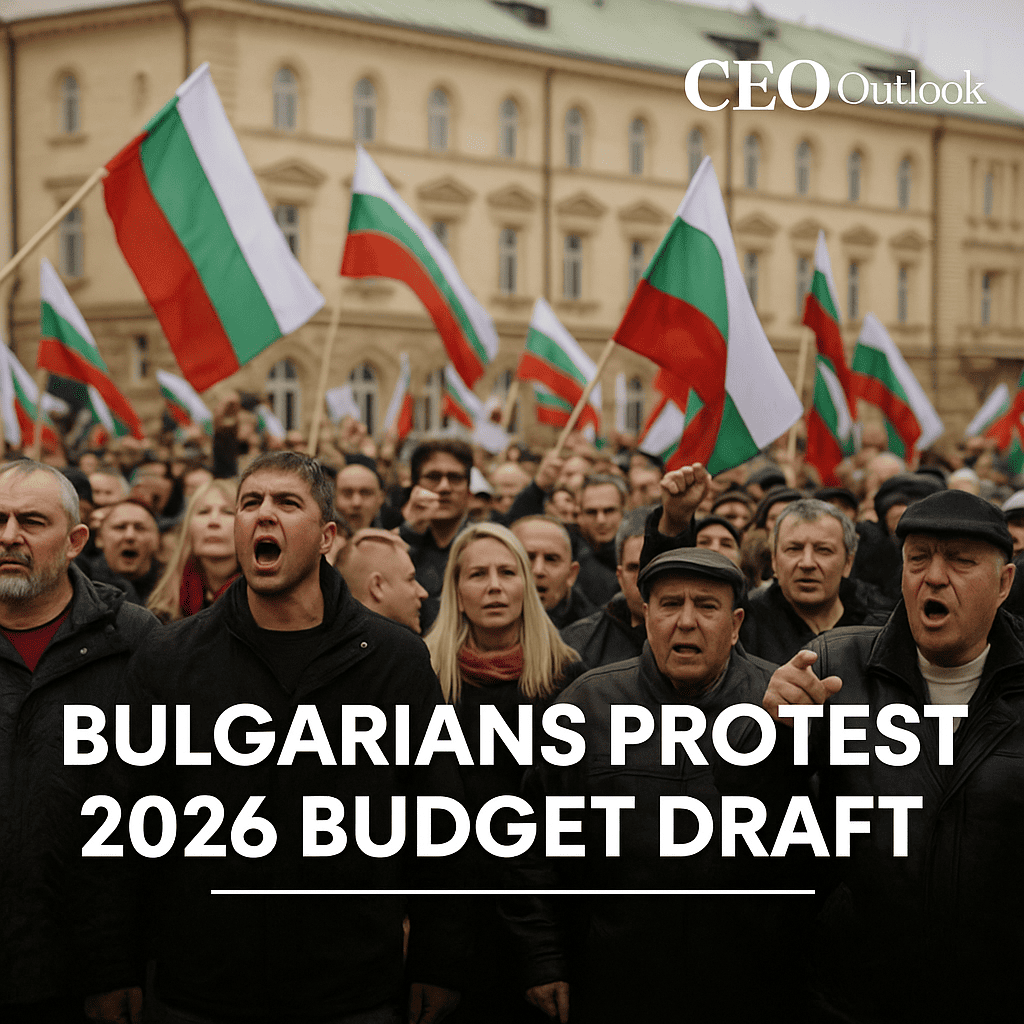
Thousands of citizens gathered outside Bulgaria’s National Assembly as Bulgarians protest 2026 budget draft measures that many view as financially punitive and socially imbalanced. The confrontation has escalated into one of the largest demonstrations of the year, exposing deep public frustration with the government’s fiscal strategy ahead of Bulgaria’s scheduled 2026 entry into the eurozone.
Crowds estimated at nearly 20,000 people filled downtown Sofia on 26 November, forming blockades around parliament and preventing MPs from exiting the building. Police struggled to contain the demonstration. Protesters attempted to break through security barriers, climbed onto police vehicles, and hurled bottles and firecrackers, leaving several officers injured. The immediate pressure forced the government to withdraw the budget draft within hours—a rare reversal for any administration.
At the center of the unrest is a fiscal package that dramatically expands state spending while introducing steep tax increases. The plan raises Bulgaria’s overall public expenditure to around 46% of GDP, financed by higher social security contributions, a doubled dividend tax, and stricter corporate tax provisions. Officials justify the measures as essential for stabilising public finances before euro adoption. Protesters reject that narrative, arguing that Bulgarians are protesting decisions in the 2026 budget draft that disproportionately target employees, freelancers, SME owners, and domestic investors.
The draft was expected to pass despite opposition efforts. But the scale of the demonstrations revealed that the dispute extends well beyond political partisanship. For many households, the tax increases come at a moment of fragile economic recovery following inflation shocks. For businesses, rising labour costs threaten competitiveness, particularly in sectors with thin margins such as agriculture, logistics, hospitality, and light manufacturing.
Economists warn that the tax increases could depress household consumption, slow investment, and push some firms back into informal operations—already a longstanding structural challenge for Bulgaria. Higher social-security contributions increase labour costs immediately. The higher dividend tax weakens incentives for SMEs to formalize profits or reinvest earnings. These ripple effects could undermine economic momentum during a critical transition year.
The government’s retreat is also connected to Bulgaria’s progress toward eurozone accession. European reports recently confirmed that Sofia meets the convergence criteria to join the euro on 1 January 2026. While this is considered a significant milestone, EU institutions stressed the importance of disciplined fiscal planning in the years leading up to entry. The government cites this as justification for front-loaded tax reforms. Critics counter that eurozone membership does not require sudden, across-the-board tax hikes and that other EU members have navigated transition periods with phased or balanced fiscal adjustments.
Civil society and academic observers highlight another dimension: the absence of meaningful public consultation. Budget proposals are often written internally by ministries and approved through fast parliamentary procedures. Protest organizers—spanning political parties, unions, employer associations, and civic groups—now argue that Bulgarians are protesting draft 2026 budget measures precisely because citizens were excluded from shaping them.
Several civil groups are calling for structural reforms, including mandatory public hearings, economic impact simulations accessible to households and businesses, and participatory budgeting tools at the municipal and national levels. These ideas aim to align Bulgaria with EU standards of inclusive fiscal governance and reduce the risk of mass protests triggered by sudden budgetary shifts.
The protests also carry implications for political legitimacy. Euro adoption is widely supported in principle, but the fiscal path toward it must appear fair and transparent. Analysts warn that if tax reforms are perceived as elite-driven or externally imposed, eurosceptic factions could exploit public resentment and undermine support for the single currency. Conversely, a revised draft that spreads changes over several years, protects vulnerable income groups, and pairs tax reforms with strong anti-corruption measures could strengthen confidence in both the government and the euro transition.
The government has now promised to reopen discussions with labour unions, employer associations, and the opposition. A revised budget is expected to include phased implementation, targeted social measures, and more transparency around spending priorities. The outcome will shape Bulgaria’s economic environment in its final year before joining the eurozone—and determine whether the unrest becomes a catalyst for a more participatory and balanced fiscal framework.
What happens next will provide a broader signal: whether Bulgaria enters the eurozone with a cohesive social consensus or under continuing public pressure. In either case, the protests have delivered a clear message—Bulgarians are protesting the 2026 budget draft because they expect the fiscal strategy to be both economically sound and socially fair.