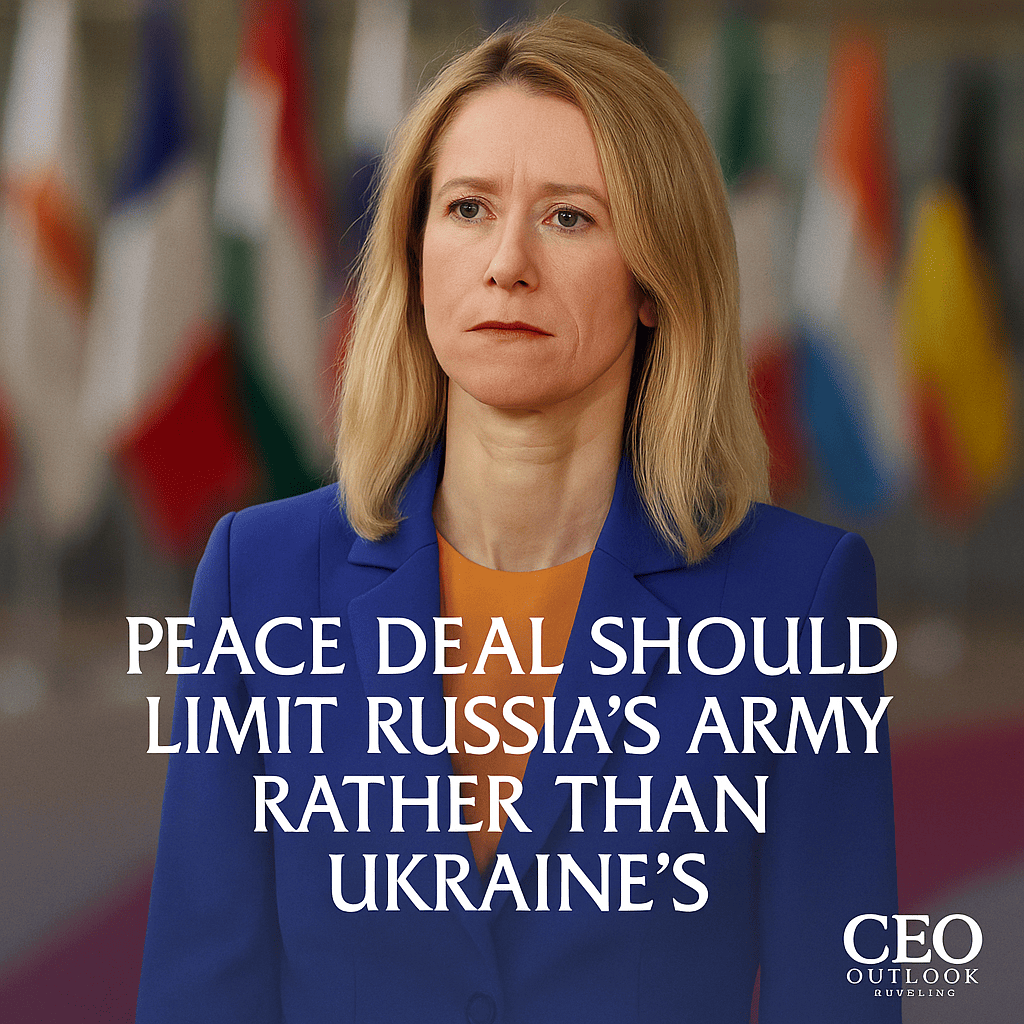
Peace Deal Should Limit Russia’s Army Rather Than Ukraine’s, Says Kaja Kallas
European leaders are pushing a unified position ahead of upcoming peace negotiations, arguing that any peace deal should limit Russia’s military rather than Ukraine’s—a direct challenge to the controversial US-Russia draft peace proposal circulating among diplomats.
During a high-level meeting in Brussels, EU foreign policy chief Kaja Kallas stressed that a peace deal should limit Russia’s military rather than Ukraine’s, because restricting Kyiv’s forces while leaving Moscow’s military buildup intact would “institutionalize risk” across Europe. Several EU officials share the view that capping Ukraine’s troop levels, as proposed in the draft plan, creates structural insecurity by weakening the victim state instead of constraining the aggressor.
The leaked US-Russia framework reportedly asks Ukraine to abandon aspirations for NATO membership, concede occupied territories in Donbas, and reduce its military to roughly 600,000 troops. European defence officials argue that accepting such conditions would create a power imbalance by forcing Ukraine into permanent military inferiority while allowing Russia to maintain a defence budget exceeding 40% of federal spending. This is why a peace deal should limit Russia’s army rather than Ukraine’s—a phrase now repeated across European capitals.
Diplomats familiar with closed-door discussions say the EU’s emerging counterproposal rejects troop caps on Ukraine and instead seeks to embed enforceable limits on Russia’s future rearmament. This includes long-term monitoring of Russian procurement networks, restrictions on missile stockpiles, and the imposition of automatic sanctions for violations. Some European officials also support attaching conditions to the release of frozen Russian assets, ensuring that funds cannot be redirected into military modernization.
Kallas noted there is “no credible indication” that Moscow is ready for a verifiable ceasefire, citing its continued mobilization efforts. Ministers from Nordic and Baltic states backed her stance, arguing that a peace deal should limit Russia’s army rather than Ukraine’s because the only sustainable peace removes Russia’s ability to rebuild offensive capability.
As diplomatic pressure intensifies and negotiations evolve, the EU’s red line remains unchanged: a peace deal should limit Russia’s army rather than Ukraine’s, protecting Ukraine’s defence autonomy while reducing the long-term military threat facing Europe.